
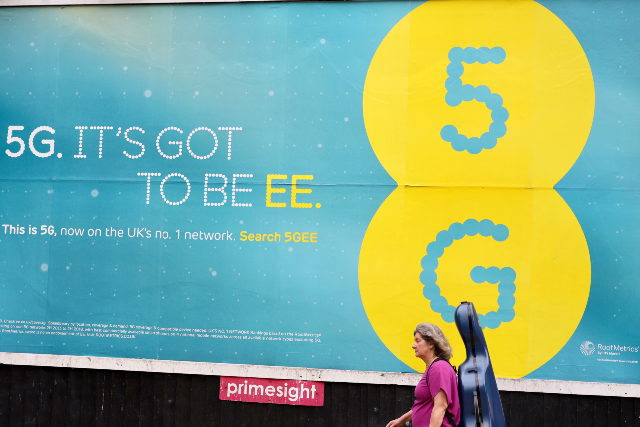
EE - This is 5G
Agency: Saatchi & Saatchi
Role: Strategy Director
The situation
EE were about to become the first network in the UK to launch 5G. They wanted to do it in style, own the category, and convert the launch moment into 5G contracts. Easy said than done, because nobody really knew what 5G was, and the people who did were either confused or actively suspicious of it.
The category playbook from around the world was already established. Driverless cars. Remote surgery. Smart cities. A very abstract, very futuristic vision of what 5G might one day enable.
The real problem
That playbook was wrong for EE for two reasons.
Firstly, it was wrong for the brand. EE is optimistic but realistic. It’s focused on what the tech of tomorrow can do today.
Secondly, and more importantly, it was wrong for the audience. Showing people a future that doesn't exist yet doesn't make them want to upgrade their phone contract. It makes them shrug. The launch needed to convert curiosity into commercial action, and abstract futurism wasn't going to do that.
The real problem wasn't "how do we explain 5G." It was "how do we make 5G feel real enough that people want it now."
The strategic shift
Stop selling the future. Show 5G working today, in places where 4G falls over.
The strategic platform I landed on was "This is 5G". A simple ownership statement, but more importantly a creative brief: every execution had to be a real demonstration of the technology, done for real, in a place where the audience would instantly understand why it mattered. No CGI. No "imagine if." Just 5G doing things 4G couldn't.
The strategic shift was from spec-led to situation-led. Bandwidth and low latency are abstract. A livestream from a Wembley crowd of 90,000 is not.
What it became
The strategic platform shaped three activations, all captured for real and then paced for TV and social.
A live broadcast from inside the FA Cup Final at Wembley, where the network was packed beyond what 4G could handle. A Bastille gig live-streamed from the middle of Birmingham New Street station at rush hour. And a man being shaved live at the top of Snowdon, where mobile signal historically didn't exist at all.
Each one took an environment where mobile networks traditionally collapsed and showed 5G working through it. The spectacle was the proof.
Why it mattered
EE became the network most associated with 5G in the UK at launch, and held that association through the early years of category competition. The platform did what the brief asked for: it made an abstract technology feel tangible, ownable and worth upgrading for."